
Reflections on meaning, purpose, and why we keep showing up
Over the weekend I read Ikigai: The Japanese Secret to a Long and Happy Life by Héctor García and Francesc Miralles (thanks to Donna Buehler for the recommendation!), and I’ve been thinking about it ever since.
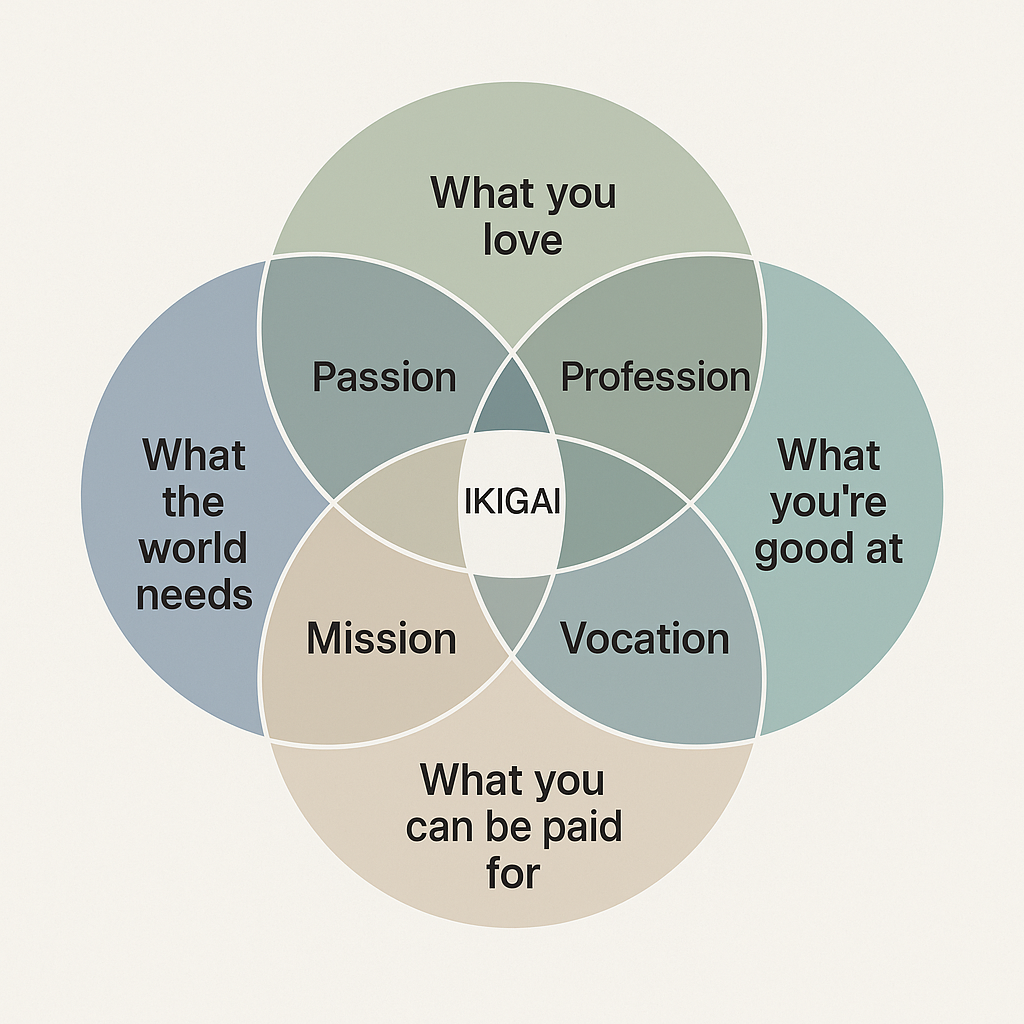
The book explores the Japanese concept of ikigai (your reason for being). You’ve probably seen the diagram: four overlapping circles showing what you love, what you’re good at, what the world needs, and what you can be paid for. Where they meet is your ikigai.
While the diagram provides a helpful framework, it was the lived experiences of the Ogimi elders, far removed from any corporate bullet points, that truly illuminated the essence of ikigai for me. The authors describe life in Ogimi, a village in Okinawa where many people live past 100. When asked about the secret to their longevity, many say the same thing: they still have a reason to get up each day. Whether it’s tending a garden, crafting something by hand, or sharing morning tea with friends, their sense of purpose is strong.
That idea stuck with me.
I started to think about when I feel most grounded in my work, not just productive or helpful, but fulfilled. For me, it’s a mix. Sometimes it’s a meaningful conversation or a connection that shifts something for someone. But other times, it’s when I’m fully immersed in writing a blog post like this one, designing a new system or framework, or building something visual that helps others understand a concept. I love the rhythm of organizing ideas, working through problems, and watching something take shape.
Those moments of focused, purposeful productivity are where I feel most “in it”. When I feel calm, engaged, clear. And if you’re task-oriented like I am, you might recognize that feeling too.
That’s what the authors call flow, a state of deep concentration and presence. It turns out, it’s one of the strongest signals we’ve tapped into our ikigai.
We don’t talk about flow enough at work, perhaps because our focus on measurable outputs often overshadows the profound impact of deep, purposeful engagement. But it shows up everywhere, in the middle of a hard conversation, in the process of building something new, in the quiet of a spreadsheet that finally makes sense. And when it does, something clicks. We feel more alive. More aligned. Sometimes even joyful.
The book also reminded me that how we live supports our ability to access that sense of purpose. The elders in Okinawa move regularly, eat mindfully, stay socially connected, and embrace a sense of community. It made me think about how our habits at work and at home shape our ability to show up with meaning.
Consider:
- When do you feel most absorbed or energized in what you’re doing?
- What part of your day brings quiet fulfillment, even if no one notices?
- What helps you stay connected to your sense of purpose when work feels hard or relationships feel strained?
You don’t need a perfectly crafted mission statement to listen for your ikigai. Sometimes, it’s enough to notice the small, meaningful moments.
As I step into a new role that blends two things I love most, connecting with others and communicating with purpose, I’ve been paying closer attention to where meaning shows up in my day. And the answer, more often than not, is in relationships and in creative, task-driven work.
In moments when someone finally feels heard.
In designing a new workflow that makes something easier.
In writing something that lands.
In watching an idea go from messy notes to a clear, visual message.
These aren’t dramatic breakthroughs, they’re part of daily workplace life. But when I’m fully present for them, I feel engaged. Energized. And yes, sometimes fulfilled.
That’s flow. And it’s worth noticing.
In my next post, I’ll explore how flow shows up in everyday work, especially when we’re navigating people dynamics, communication challenges, or creative problem-solving, and how we can design for more of it.
So, have I found my ikigai? Rather than a definitive destination, I’ve come to realize it’s about learning to listen more closely to where meaning quietly emerges, often in the real, human, everyday moments of work.
Curious about the book? I highly recommend checking it out: Ikigai: The Japanese Secret to a Long and Happy Life
And thank you again to Donna Buehler for nudging this book onto my reading list. It came at just the right time.
By: Elizabeth Hill, Associate Director, University of Colorado Boulder Ombuds Office and Co-editor of Ombuzz